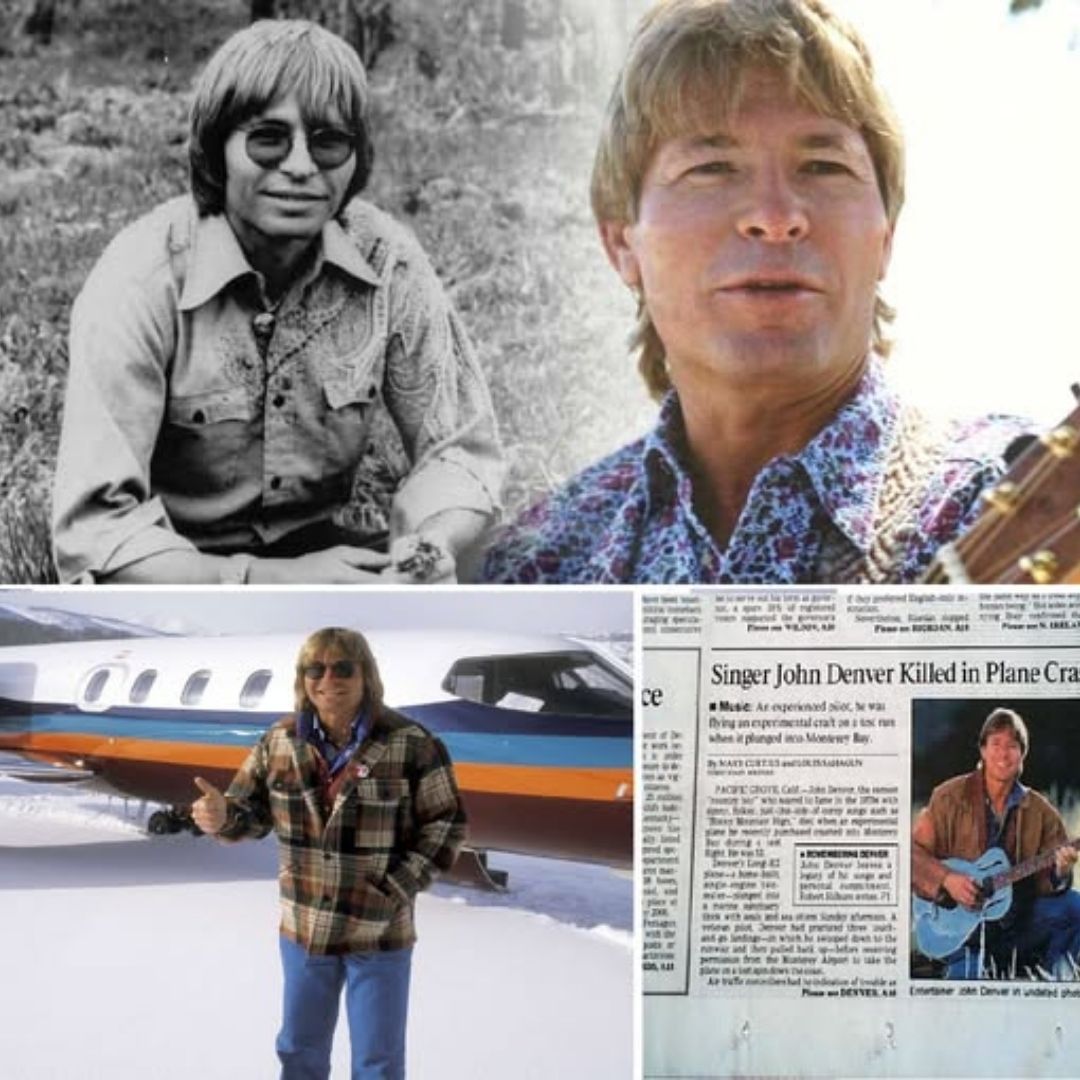
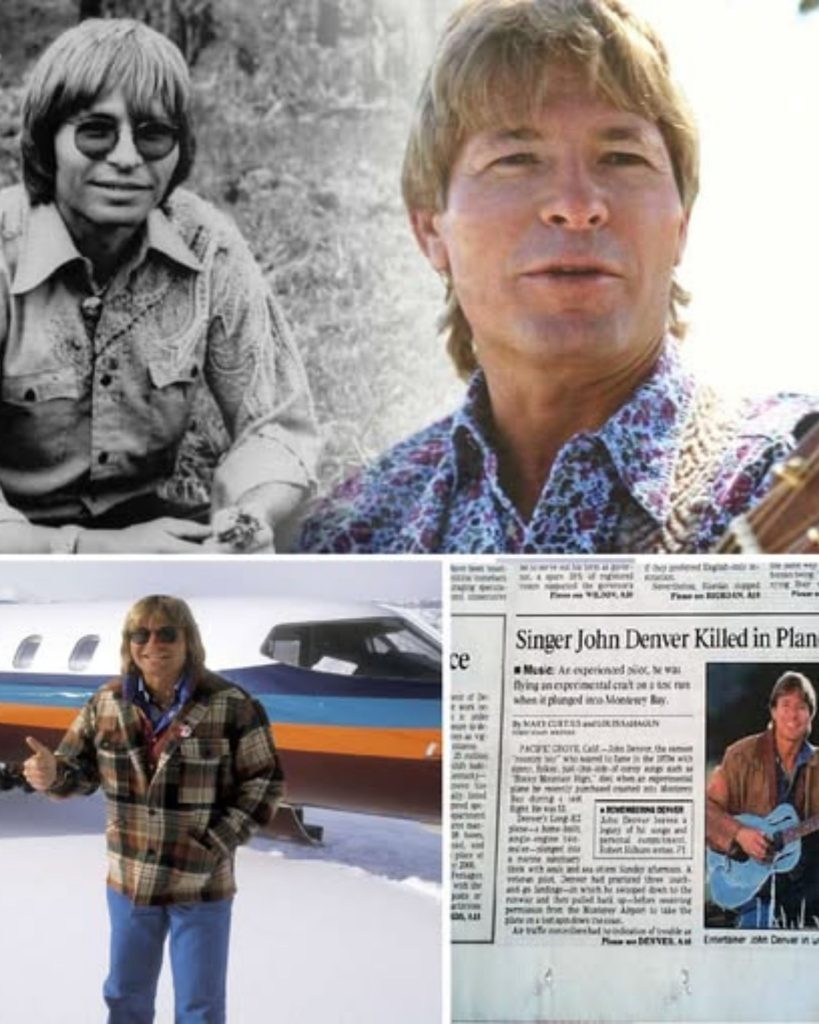
A Pilot’s Soul in a Musician’s Body
For John Denver, the sky was never just a backdrop — it was part of who he was.
From the way he sang “Sunshine on My Shoulders” to the soaring imagery of “Rocky Mountain High”, flight, freedom, and nature ran through his veins. Long before he became a global icon, Denver had already earned his pilot’s license. Flying was his sanctuary — a place where he could escape fame’s noise and reconnect with the boundless horizon he so often wrote about.
Friends used to say he looked most alive when his hands were on the yoke, the wind against his face, and his voice humming a tune no microphone could capture. But on October 12, 1997, that passion — the same one that gave his life meaning — would also bring it to a heartbreaking end.
Monterey Bay, California – The Final Flight

It was a calm Sunday afternoon when John Denver climbed into his experimental aircraft, a small two-seat Rutan Long-EZ plane. He was flying solo, as he often did, from the Monterey Peninsula Airport. Witnesses later recalled how the plane took off smoothly and began performing gentle maneuvers over the shimmering bay.

Then, suddenly — in a quiet stretch of sky — something went wrong.

At around 5:28 p.m., the plane plunged into the cold waters of Monterey Bay, just a few hundred yards from shore. Rescue teams arrived swiftly, but it was too late. John Denver was 53 years old.

The investigation would later reveal that the fuel selector valve was placed behind the pilot’s seat — nearly impossible to reach while flying. When Denver tried to switch to his reserve tank, he lost control of the aircraft. It was a tragic flaw in design, compounded by fate.

The Man Who Sang the World Home

By the time of his death, John Denver had already sold over 33 million albums, spreading his gentle voice and message of peace across the globe. His songs weren’t just melodies; they were homes for the weary.
He sang of love that didn’t demand, of mountains that healed, of the Earth that breathed with us.

In an era of electric guitars and urban angst, Denver’s music reminded people of something purer — the smell of pine, the touch of rain, the sound of wind echoing through the Rockies.

He wasn’t just a singer. He was a poet of the open sky.

 From the Rockies to the Kremlin

Denver’s warmth reached far beyond America. In 1985, during the height of the Cold War, he became one of the few Western musicians invited to perform in the Soviet Union. While politicians argued about missiles, Denver sang “Let Us Begin (What Are We Making Weapons For?)” — turning a tense political moment into a human one.

His concert was broadcast across the USSR, and millions of people — many who had never heard Western pop before — were moved to tears. He didn’t need to take sides; his voice did what diplomacy couldn’t.

 An Environmental Pioneer

Long before “climate change” became a household phrase, John Denver was already an activist for nature. He founded the Windstar Foundation, advocating for sustainable living and environmental awareness.

He once said:

“We don’t own the land, we belong to it.”

That philosophy ran deep in everything he wrote — from “Take Me Home, Country Roads” to “Calypso”, his tribute to ocean explorer Jacques Cousteau. He gave voice to the Earth itself, and in return, the Earth seemed to cradle him in those final moments over Monterey Bay.

 The Day the Music Stopped

The world mourned in disbelief. Vigils were held in Aspen, Colorado — his spiritual home — where fans gathered beneath the clear mountain stars, singing “Annie’s Song” through their tears.
Elton John, Olivia Newton-John, and countless artists paid tribute, remembering him as “the kindest soul in the business.”

In Washington D.C., lawmakers even paused to honor his legacy, acknowledging not just his music, but his humanitarian work and his deep love for the planet.

It was as if the sky itself had fallen silent that day.

“Fly Away” – The Eternal Echo

Listening to Denver now feels almost prophetic. His 1975 hit “Fly Away” — a wistful duet with Olivia Newton-John — tells of a yearning soul who dreams of leaving everything behind, just to find peace in the clouds:

“Fly away, fly away, fly away…
Life in the city can make you crazy.”

In hindsight, it sounds like a farewell letter written decades in advance.
On that October evening, perhaps he did just that — flew away into the boundless blue he always sang about.

Legacy That Keeps Soaring

Today, John Denver’s music continues to echo through mountain cabins, open highways, and quiet hearts. His songs are still played at weddings, funerals, and family gatherings — wherever people seek warmth and sincerity.

A bronze statue of him now stands at the Aspen airport, arms wide open, eyes lifted toward the sky. Pilots passing through often nod in respect — one aviator to another.

Because in the end, John Denver didn’t crash.
He ascended — into the eternal expanse he’d always loved.

Video

Related Post

THEY GOT MARRIED ON A CONCERT STAGE IN WICHITA. LESS THAN THREE YEARS LATER, JEAN SHEPARD WAS LEFT WITH TWO SONS AND A HUSBAND COUNTRY MUSIC COULD ONLY HEAR ON RECORDS. They met inside the world that had already claimed both of them — radio shows, road dates, the Grand Ole Opry, dressing rooms, and the kind of touring life where a singer’s home could feel like whatever town had the next stage. Jean was not fragile. She had already fought her way into hard country when women were still expected to sound sweeter than the men around them. “A Dear John Letter” had taken her to No. 1. The Opry had taken her in. She had survived one bad early marriage and kept her career anyway. Hawkshaw was different. Six-foot-five. Smooth. Charismatic. A West Virginia singer people called “Eleven Yards of Personality.” He had the height, the grin, and the kind of stage presence that made a crowd feel like he had walked in from a bigger life. On November 26, 1960, they married onstage during a concert in Wichita, Kansas. It was not just a courthouse promise. Ken Nelson gave Jean away. A local disc jockey broadcast the ceremony over the radio. The crowd was there. The music world was there. Their private vow entered country history through a microphone. For a while, it looked like the show and the marriage could live together. They toured. They built a home in Goodlettsville. They had a son, Don Robin, named after friends Don Gibson and Marty Robbins. Jean became pregnant again. Then the calendar turned cruel. The marriage that had started in front of an audience ended with Jean carrying the part no audience could sing for her — a toddler, an unborn child, and a husband whose voice kept climbing the chart after he was gone.

JEAN SHEPARD CUT “LONESOME 7-7203” BEFORE HER HUSBAND DID. CAPITOL LEFT IT SITTING. THEN HAWKSHAW HAWKINS RECORDED IT — AND DIED THREE DAYS AFTER ITS RELEASE. The song did not start as Hawkshaw Hawkins’ last hit. It passed through Jean Shepard first. By the early 1960s, Jean was already one of country music’s toughest women. She had come up through honky-tonk, made “A Dear John Letter” a No. 1 duet, joined the Grand Ole Opry, and proved she was not just a pretty harmony voice in a man’s business. Hawkshaw Hawkins was already part of that same Opry world. Tall, smooth, steady, with a career that had stretched from West Virginia radio to national country stages. He and Jean married in 1960. Two singers. Two roads. One house outside Nashville. Then came a Justin Tubb song called “Lonesome 7-7203.” Jean recorded it for Capitol, but the label left it unreleased. The song sat there. A lonely telephone number. A heartbreak line waiting for somebody to dial it. Hawkshaw finally told her that if Capitol was not going to release it, he would record it himself. King Records released his version on March 2, 1963. Three days later, Hawkshaw Hawkins was dead. The plane crash near Camden took him, Patsy Cline, Cowboy Copas, and pilot Randy Hughes. Jean was left with the grief, the children, and the strange sound of her husband’s voice still rising on the radio. Then the song climbed. “Lonesome 7-7203” reached No. 1 after Hawkshaw was gone. Jean had recorded it first. Hawkshaw made it immortal. Country music kept dialing the number after the man who sang it could no longer answer.

SHE SAID A MAN WITH A GUN WAS WAITING IN THE BACK SEAT. DAYS LATER, TAMMY WYNETTE STILL WALKED ONSTAGE IN SOUTH CAROLINA. Tammy Wynette already knew what it meant to sing pain for a living. By 1978, she was not just a country star. She was the woman behind “Stand by Your Man,” “D-I-V-O-R-C-E,” “I Don’t Wanna Play House,” and the kind of songs that made broken homes sound like they had wallpaper, bills, children, and nowhere clean to hide. Her life had become part of the story too. Marriages. George Jones. Public fights. Illness. A voice that could make surrender sound noble even when the woman singing it was barely holding the pieces together. Then came October 4, 1978. Tammy had gone shopping at Green Hills in Nashville for a birthday gift for her daughter. When she returned to her car, she later said a masked man was hiding in the back seat with a gun. He forced her to drive, beat her, and released her about 80 miles away in Giles County. The story sounded like something too strange even for country music. Questions followed. Rumors followed. No one was ever convicted. The mystery stayed attached to her name for the rest of her life. But Tammy still had a calendar. A few days later, bruised and shaken, she appeared for a concert in Columbia, South Carolina. The fans saw the First Lady of Country Music under the lights. What they could not fully see was the woman who had just been left on a Tennessee roadside, trying to explain a nightmare nobody could neatly close. Loretta Lynn turned poverty into defiance. Patsy Cline turned survival into steel. Tammy Wynette turned private wreckage into a voice so controlled it almost hid the damage.

You Missed

THEY GOT MARRIED ON A CONCERT STAGE IN WICHITA. LESS THAN THREE YEARS LATER, JEAN SHEPARD WAS LEFT WITH TWO SONS AND A HUSBAND COUNTRY MUSIC COULD ONLY HEAR ON RECORDS. They met inside the world that had already claimed both of them — radio shows, road dates, the Grand Ole Opry, dressing rooms, and the kind of touring life where a singer’s home could feel like whatever town had the next stage. Jean was not fragile. She had already fought her way into hard country when women were still expected to sound sweeter than the men around them. “A Dear John Letter” had taken her to No. 1. The Opry had taken her in. She had survived one bad early marriage and kept her career anyway. Hawkshaw was different. Six-foot-five. Smooth. Charismatic. A West Virginia singer people called “Eleven Yards of Personality.” He had the height, the grin, and the kind of stage presence that made a crowd feel like he had walked in from a bigger life. On November 26, 1960, they married onstage during a concert in Wichita, Kansas. It was not just a courthouse promise. Ken Nelson gave Jean away. A local disc jockey broadcast the ceremony over the radio. The crowd was there. The music world was there. Their private vow entered country history through a microphone. For a while, it looked like the show and the marriage could live together. They toured. They built a home in Goodlettsville. They had a son, Don Robin, named after friends Don Gibson and Marty Robbins. Jean became pregnant again. Then the calendar turned cruel. The marriage that had started in front of an audience ended with Jean carrying the part no audience could sing for her — a toddler, an unborn child, and a husband whose voice kept climbing the chart after he was gone.

JEAN SHEPARD CUT “LONESOME 7-7203” BEFORE HER HUSBAND DID. CAPITOL LEFT IT SITTING. THEN HAWKSHAW HAWKINS RECORDED IT — AND DIED THREE DAYS AFTER ITS RELEASE. The song did not start as Hawkshaw Hawkins’ last hit. It passed through Jean Shepard first. By the early 1960s, Jean was already one of country music’s toughest women. She had come up through honky-tonk, made “A Dear John Letter” a No. 1 duet, joined the Grand Ole Opry, and proved she was not just a pretty harmony voice in a man’s business. Hawkshaw Hawkins was already part of that same Opry world. Tall, smooth, steady, with a career that had stretched from West Virginia radio to national country stages. He and Jean married in 1960. Two singers. Two roads. One house outside Nashville. Then came a Justin Tubb song called “Lonesome 7-7203.” Jean recorded it for Capitol, but the label left it unreleased. The song sat there. A lonely telephone number. A heartbreak line waiting for somebody to dial it. Hawkshaw finally told her that if Capitol was not going to release it, he would record it himself. King Records released his version on March 2, 1963. Three days later, Hawkshaw Hawkins was dead. The plane crash near Camden took him, Patsy Cline, Cowboy Copas, and pilot Randy Hughes. Jean was left with the grief, the children, and the strange sound of her husband’s voice still rising on the radio. Then the song climbed. “Lonesome 7-7203” reached No. 1 after Hawkshaw was gone. Jean had recorded it first. Hawkshaw made it immortal. Country music kept dialing the number after the man who sang it could no longer answer.

SHE SAID A MAN WITH A GUN WAS WAITING IN THE BACK SEAT. DAYS LATER, TAMMY WYNETTE STILL WALKED ONSTAGE IN SOUTH CAROLINA. Tammy Wynette already knew what it meant to sing pain for a living. By 1978, she was not just a country star. She was the woman behind “Stand by Your Man,” “D-I-V-O-R-C-E,” “I Don’t Wanna Play House,” and the kind of songs that made broken homes sound like they had wallpaper, bills, children, and nowhere clean to hide. Her life had become part of the story too. Marriages. George Jones. Public fights. Illness. A voice that could make surrender sound noble even when the woman singing it was barely holding the pieces together. Then came October 4, 1978. Tammy had gone shopping at Green Hills in Nashville for a birthday gift for her daughter. When she returned to her car, she later said a masked man was hiding in the back seat with a gun. He forced her to drive, beat her, and released her about 80 miles away in Giles County. The story sounded like something too strange even for country music. Questions followed. Rumors followed. No one was ever convicted. The mystery stayed attached to her name for the rest of her life. But Tammy still had a calendar. A few days later, bruised and shaken, she appeared for a concert in Columbia, South Carolina. The fans saw the First Lady of Country Music under the lights. What they could not fully see was the woman who had just been left on a Tennessee roadside, trying to explain a nightmare nobody could neatly close. Loretta Lynn turned poverty into defiance. Patsy Cline turned survival into steel. Tammy Wynette turned private wreckage into a voice so controlled it almost hid the damage.

“ I FORGOT MORE THAN YOU’LL EVER KNOW” WAS STILL RISING WHEN THE CAR CRASH KILLED BETTY JACK DAVIS AND LEFT SKEETER ALIVE TO SING UNDER THE SAME NAME. The Davis Sisters were not really sisters. Skeeter Davis was born Mary Frances Penick. Betty Jack Davis was her friend, her singing partner, and the other half of a harmony country music had not heard enough of yet. They were young, close, and just strange enough together to make the name feel true. In 1953, RCA released “I Forgot More Than You’ll Ever Know.” The record started moving fast. It went to No. 1 on the country chart and crossed into the pop world too. For two young women in country music, that was not just a hit. It was a door most people did not expect them to open. Then came the road home. After a show in Wheeling, West Virginia, the two left after midnight, heading back toward Kentucky. Near Cincinnati on August 2, 1953, another driver fell asleep at the wheel and crashed head-on into the car carrying them. Betty Jack was killed. Skeeter survived with serious injuries. The song kept climbing while one half of the duo was gone. Later, Skeeter returned under the Davis Sisters name with Betty Jack’s sister, Georgia. They recorded and toured, but everyone knew something had changed. A harmony can be copied on paper. It cannot always be brought back to life. Years later, Skeeter stood alone and sang “The End of the World.” Most listeners heard heartbreak. Skeeter had already learned what it sounded like when the world ended and the record kept playing.