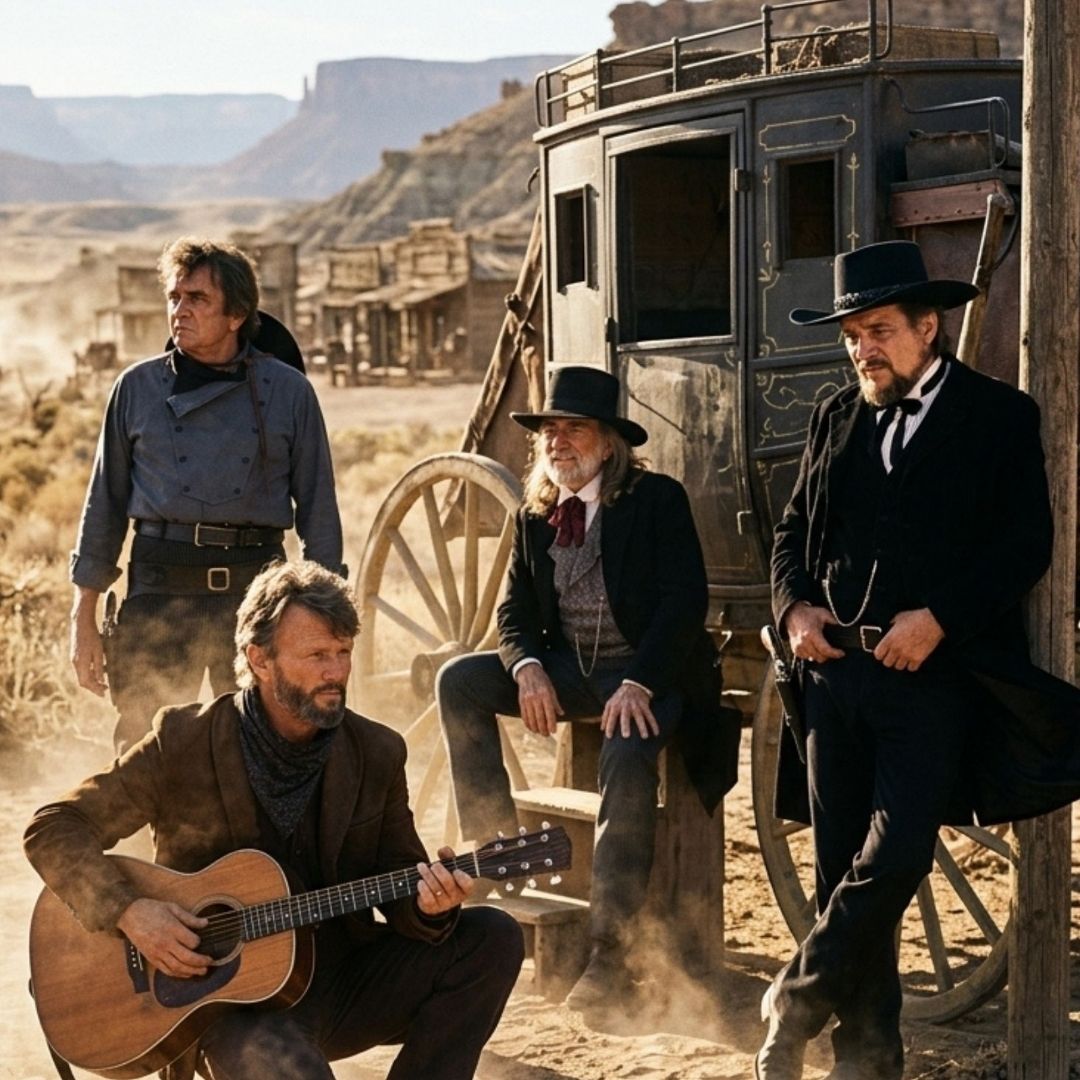
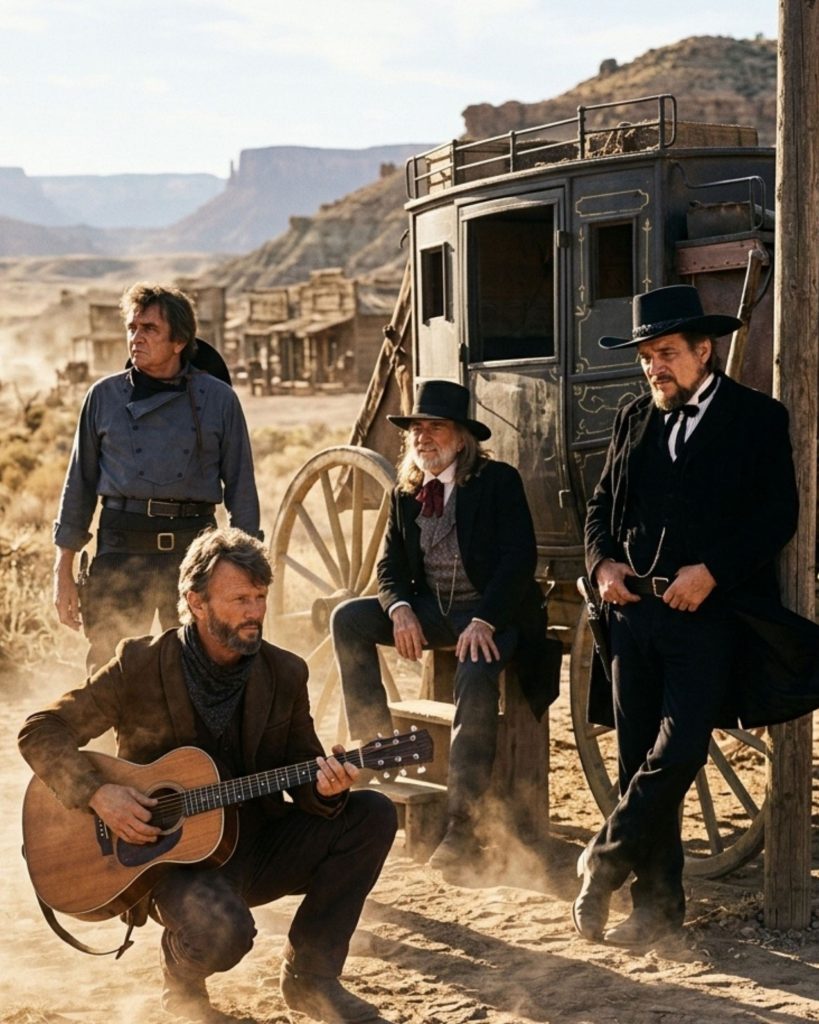
Each Man Had Already Built His Own Country Before They Ever Stood In The Same Song
Johnny Cash had already walked into Folsom Prison and recorded in front of inmates when much of the industry still would not have touched that room. Willie Nelson had already become a founder of Farm Aid, turning his fame toward families losing their farms. Waylon Jennings had already helped force open the outlaw-country lane by pushing back against Nashville control. Kris Kristofferson had already walked away from the life people expected of him, turned down the safer road, worked odd jobs in Nashville, and written songs for people whose damage never sounded tidy.
That is what makes the Highwaymen story feel so different from an ordinary supergroup story.
They did not arrive as unfinished men looking for identity.
They arrived as four identities already too large to need help.
“Highwayman” Worked Because The Song Was Big Enough To Hold Four Lives At Once
When they recorded “Highwayman” in 1985, the song gave them something rare: a structure large enough for each man to sound fully himself while still belonging to one shared myth. Johnny Cash’s official archive lists the Highwayman album as a 1985 release, and the title track became the song that gave the quartet both its name and its lasting public image.
That is why the record never felt like a label invention.
Four verses.
Four voices.
Four different kinds of weather inside the same storm.
Jimmy Webb had written the song years earlier, but once Cash, Nelson, Jennings, and Kristofferson stepped into it, the thing stopped sounding like a composition and started sounding like identity.
The Group Felt Bigger Than Business Because The Friendships Were Already There
The Highwaymen were not built out of blank corporate chemistry. Johnny Cash’s official site dates the group’s formation to 1984, and later documentary material traces their closeness to the Montreux Christmas-special trip where the four men and their families spent real time together away from the stage.
That matters because it explains the looseness people always heard in them.
They did not sound like four stars taking turns.
They sounded like men who already knew each other’s weight.
You can hear that in the way the voices pass the song around. Nobody is trying to dominate it. Nobody is trying to prove he is the center. Each man enters, leaves, and trusts the others to keep carrying the road.
The Song Went To No. 1, But The Deeper Story Is What Kind Of Men It Joined Together
“Highwayman” hit No. 1 on the country chart, and from there the group became one of the defining symbols of outlaw-country mythology.
But the chart does not explain why the song still feels larger than many bigger hits.
Cash had sung for prisoners and for people standing outside respectability. Willie had turned himself into one of country music’s most public champions of struggling farmers. Waylon had fought to make artistic control part of his life instead of a privilege handed down by Nashville. Kris had spent his writing life giving dignity to drifters, failures, wanderers, and men too bruised to speak cleanly for themselves.
Put those four instincts in one room and the result was always going to sound larger than performance.
It sounded like country music reaching back for the people it had a habit of leaving outside the bright center.
Now Willie Carries The Name Alone
Johnny Cash is gone.
Waylon Jennings is gone.
Kris Kristofferson is gone.
Willie Nelson, born April 29, 1933, is now 92 and the last living Highwayman.
That fact changes the whole image of the group now. The old quartet is no longer just a monument in the history of country music. It has become a road with one surviving traveler still walking it. The song that once sounded like four men refusing to disappear now carries a quieter ache: one voice still here, three others living in the shape of the harmony.
What The Story Leaves Behind
The version worth keeping is not just that the Highwaymen were four famous men who made a No. 1 song together in 1985.
It is that each of them had already spent years singing toward a different set of forgotten people, and somehow those four roads met inside one record. Cash brought prisoners and strays. Willie brought farmers and survivors. Waylon brought rebels and men tired of being managed. Kris brought the broken, the drifting, and the half-lost.
Together, they made a song big enough to sound like all of them at once.
And that is why “Highwayman” still feels less like a supergroup hit than a piece of American memory.
Video